Every artwork has a story.
Sometimes the story begins with a profound idea, a personal experience, or a moment of inspiration.
Sometimes it begins with a joke.
Not long ago, someone said to me with a smile, “You’re not an Asian artist until you have a koi fish or horse painting in your portfolio.”
I laughed.
The comment wasn’t meant to offend. In fact, it was made in good humour. But like many jokes, it lingered long after the conversation ended.
Why do we associate certain subjects with certain artists?
Why do we assume that an artist’s ethnicity should somehow dictate what appears on their canvas?
The more I thought about it, the more curious I became.
And perhaps that curiosity is what eventually led to Current.
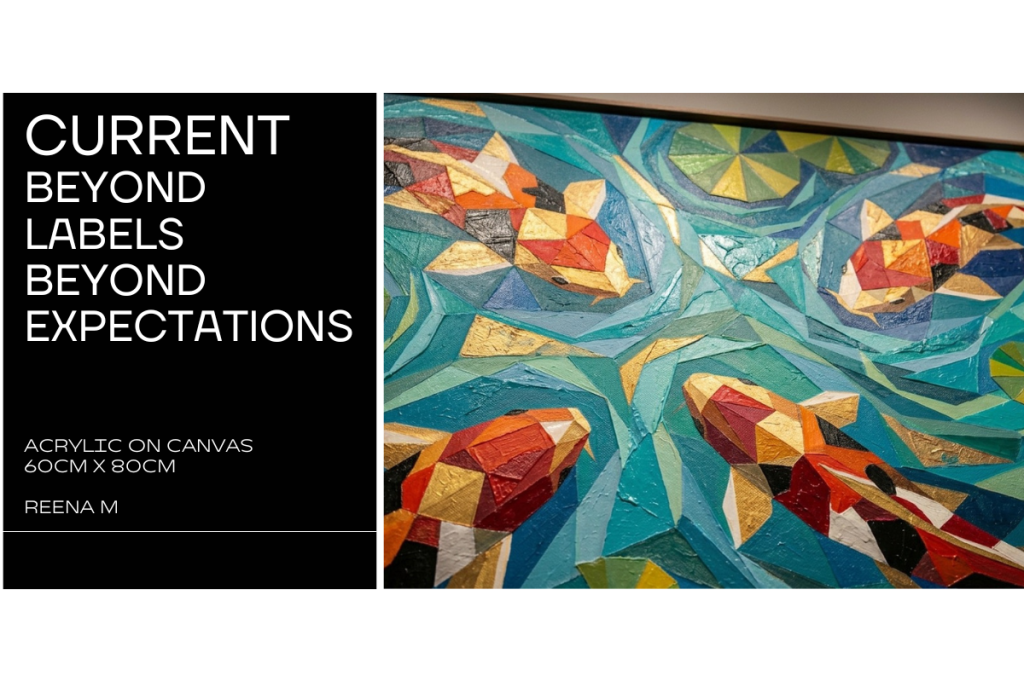
At first glance, the painting appears to feature koi swimming through water. The familiar orange, white, black, and red forms are immediately recognizable. Yet the longer one spends with the work, the more it becomes clear that the koi are not really the subject.
Movement is.
Connection is.
Flow is.
The painting emerged through my ongoing fascination with cubist language and geometric abstraction. Rather than painting fish in a traditional sense, I wanted to deconstruct them into fragments of colour, shape, and rhythm. I wanted the viewer to experience movement rather than simply observe it.
Each plane of colour became a note in a larger visual composition.
The water is not painted as water.
Instead, it becomes a network of intersecting shapes and currents. Blues shift into turquoise. Turquoise breaks into emerald. Geometry bends into circles, spirals, and pathways. The koi appear and disappear within these structures, becoming part of the current rather than separate from it.
In many ways, the painting mirrors life itself.
We often imagine ourselves as independent beings moving through the world. Yet beneath the surface, our lives are interconnected by invisible currents. Relationships, experiences, memories, opportunities, losses, victories, and challenges all shape the direction we travel.
The koi become symbols of that shared journey.
Not symbols tied to any one culture or tradition.
Not symbols confined by geography.
Simply participants in the same flow.
That is why the title Current felt right.
A current is movement.
A current is energy.
A current is the present moment.
A current is an invisible force carrying us forward.
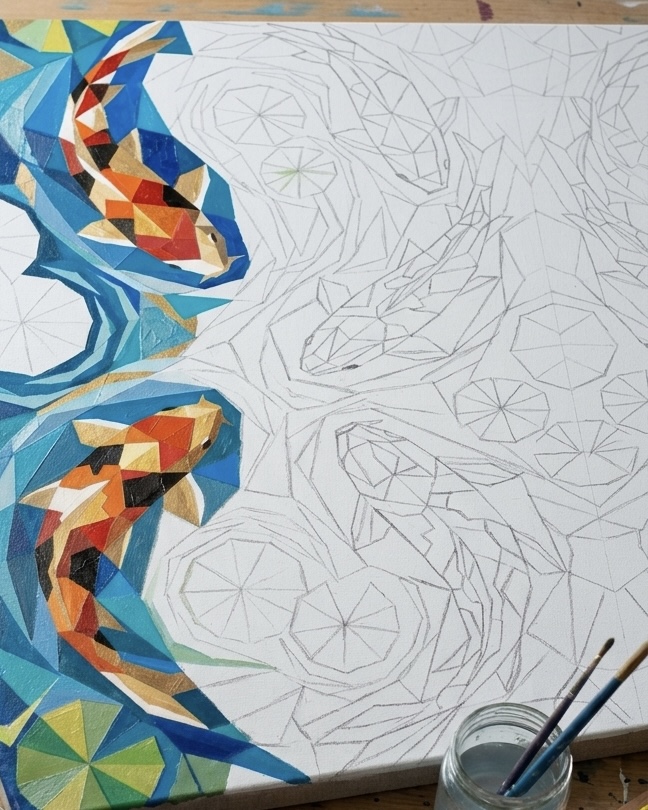
The title allows the work to exist beyond the subject matter. It invites viewers to reflect on their own movement through life and their own relationship with change.
Ironically, the painting that began as a reflection on artistic stereotypes became an exploration of something far more universal.
The conversation around identity in art is an interesting one.
There is no doubt that culture influences artists. Our experiences shape us. The places we grow up, the stories we inherit, the people around us, and the environments we inhabit inevitably leave their mark on our creative voice.
But influence and limitation are not the same thing.
An artist can be inspired by heritage without being confined by it.
An artist can honour tradition without becoming defined by it.
The beauty of art lies precisely in its ability to cross boundaries.
When we stand before a painting, we rarely ask whether colour belongs to a particular nationality.
We rarely wonder whether movement belongs to one culture and not another.
We respond to emotion.
We respond to beauty.
We respond to meaning.
Those responses are universal.
As Current developed in the studio, I found myself thinking less about koi and more about connection.
The repeating circular forms began to resemble ripples extending outward.
The geometric patterns started to feel like conversations between order and freedom.
The fish moved through these spaces as if navigating life’s uncertainties.
Nothing remains still.
Everything is in motion.
That idea has become a recurring thread throughout much of my work.
The belief that life is not a fixed destination but an unfolding process.
The belief that growth occurs through movement.
The belief that meaning often reveals itself only when we allow ourselves to flow with change rather than resist it.
Perhaps that is why viewers often connect with the work even if they cannot immediately explain why.
They recognize something familiar within it.
Not the fish.
Not the geometry.
Not the colours.
The movement.
Because every person understands movement.
Every person understands transition.
Every person understands the feeling of being carried toward something unknown.
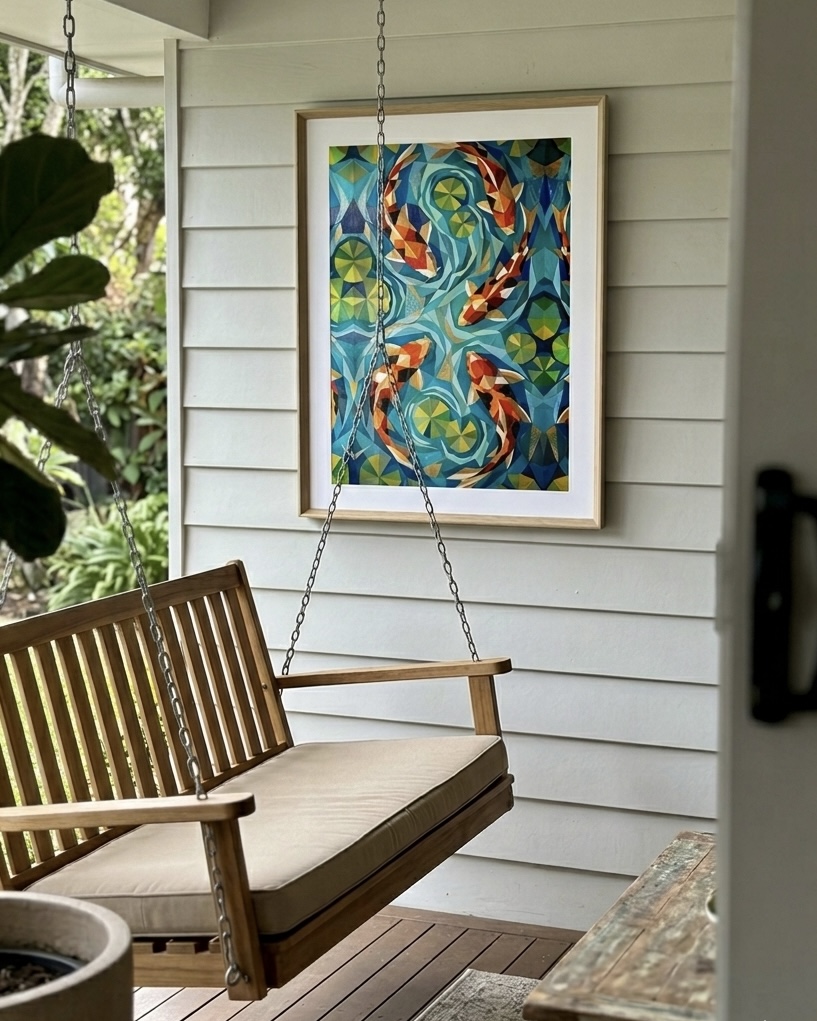
Recently, I received a photograph from the collector who acquired the piece.
Seeing Current installed in its new home was a deeply rewarding moment.
The painting now hangs on a quiet wall overlooking a beautiful outdoor space. A wooden swing sits nearby. Natural light moves across the surface throughout the day. The surrounding greenery echoes the colours within the artwork itself.
What was once a collection of sketches, ideas, and experiments inside my studio has now become part of someone else’s daily environment.
That transition is one of the most meaningful parts of being an artist.
A painting begins as something intensely personal.
It exists only between the artist and the canvas.
Yet eventually it leaves.
It finds a new home.
A new context.
A new audience.
And in doing so, it gains new layers of meaning.
The collector will bring experiences to the work that I never could.
They will notice different details.
Associate different memories.
See different stories.
That is the beautiful exchange that occurs whenever art changes hands.
The artwork may have originated with the artist, but it ultimately belongs to everyone who encounters it.
And perhaps that is the final irony of this story.
A painting inspired in part by a conversation about labels ended up proving how little labels matter.
People connect with authenticity.
People connect with emotion.
People connect with stories.
Not categories.
Not assumptions.
Not stereotypes.
The work resonated because it spoke to something universal.
And before anyone asks
No, this is not an Asian buyer.
It turns out that movement, colour, beauty, and meaning don’t require a shared ethnicity to be appreciated.
They simply require a human connection.
Reena M
Still In Motion – If you’re interested in owning a giclée print of Current, I have prints available here: Current Giclee Print
Collector Review
“We were immediately drawn to the energy of the piece. Every time we look at it, we discover something new the movement, the colours, the layers within the composition. It brings a sense of life and calm to the space at the same time. We knew exactly where it belonged the moment we saw it. Thank you for creating something that continues to reveal itself each day.”
 Art Beyond Canvas
Leave a comment